
How we made six 3D printed mascots for Amijami Sushi
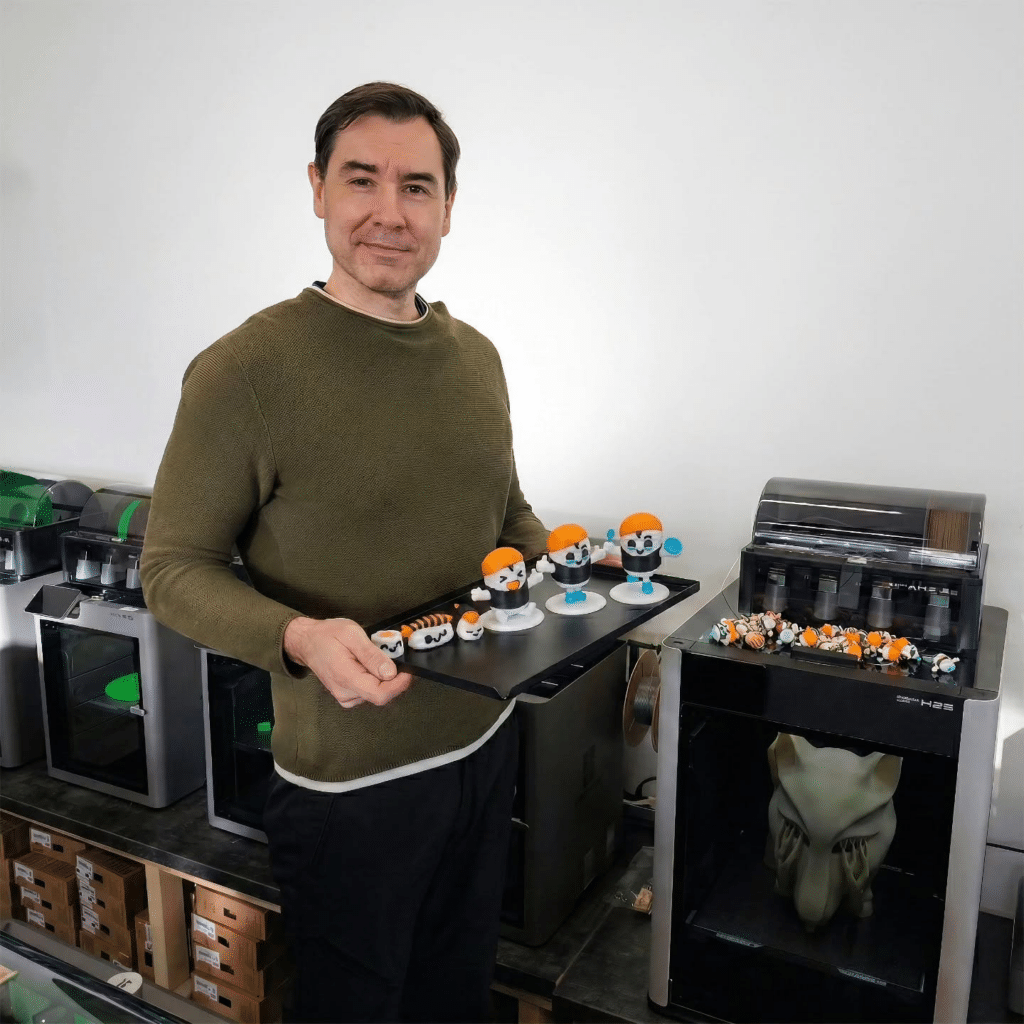
The first time we put one of Amijami Sushi’s mascots on a fridge, it turned upside down. It had looked perfectly balanced on the screen. On a vertical door, the little character’s outstretched arms made its top half heavier than its feet.
This started as a request from a sushi restaurant here in Tallinn. They wanted to put their own characters in their children’s meals, and they had six flat vector illustrations in four colours. Our designer had to turn each drawing into a figure you could recognise from the side and the back. We made the 3D printed mascots on a printer that changes filament during a print.
We considered a pencil topper, a keyring and a fridge magnet. The pencil opening would have taken up the space we needed for the magnet. Cutting the figures in half would have given them a flat back, but we liked them much better in the round. We kept the whole figure, added a keyring loop and paused the printer to insert the magnet. The next layers closed over it.
That first fridge test sent us back to the models. We shifted the balance, and gave the character holding a heavy megaphone two magnets. A flat stand would have got in the way on the fridge, so we left it off. The loop also needed more material. By about the twentieth iteration it was noticeably thicker, and we had tried shrinkage allowances from 0.5% down to 0.05% to get a snug fit for the magnet during the print.
Printing one good figure was easier than printing a full plate of them. We adjusted overhangs on hats, levelled parts of the seated characters and reworked some rings on their bodies. One 20 gram figure could produce around 60 grams of waste as the printer switched colours. Levelling a slightly tilted detail meant fewer colour changes per layer, with hardly any difference to the character’s silhouette.
We had planned to put Amijami’s logo underneath each figure. In the end we printed it in contrasting white on the belt, where you can actually see it. After dozens of test prints, all six designs were ready for the restaurant’s children’s combos. The tallest was only 4.5 centimetres.


