
Your first 3D printed prototype, from sketch to fit test
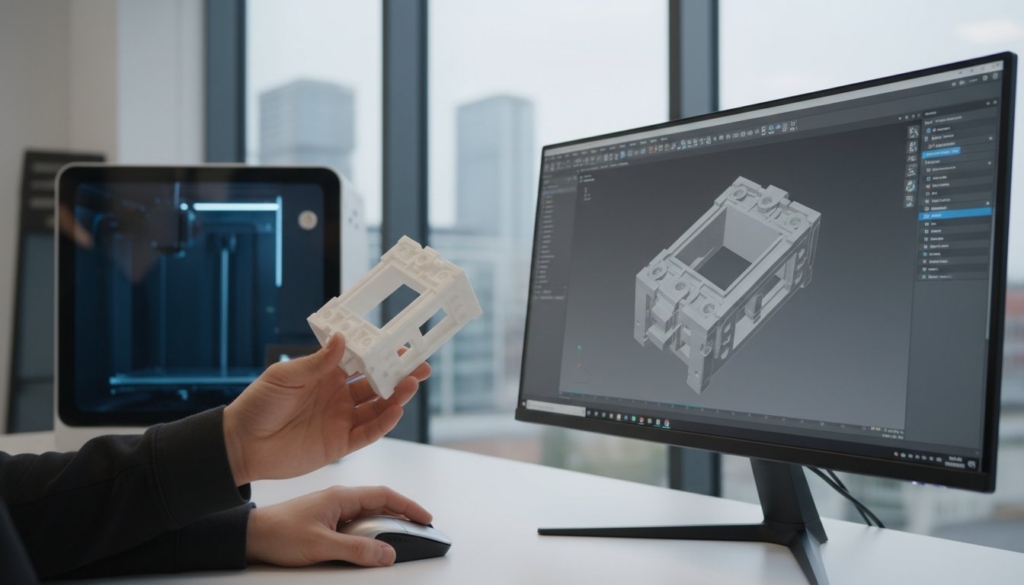
Say you’re designing a little housing for a switch. You could spend time choosing the colour and polishing the outside, then discover the plug won’t fit through the hole. A better first 3D printed prototype might be just the front wall, the opening and two fixing points. It answers the most expensive question with a fraction of the print.
Give the first version one question
Are you checking what the object feels like in a hand, whether two parts fit or how the finished object looks on a shelf? Mark the important dimensions on a sketch. Show what it sits beside and where a screw, cable or moving part needs clearance. If you have an existing component, a photo with dimensions helps explain which faces meet.
A CAD model is useful if you have one. Send the editable model alongside an STL or 3MF export and state the units. A file can look accurate on screen while a thin wall, an open surface or a missing clearance causes trouble in print. With only a drawing, you can still ask for help turning it into a model. Identify which dimensions you’ve measured and which are provisional.
| Stage | What to keep |
|---|---|
| Brief and model | Dimensions, a sketch and the one question the print must answer. |
| First print | A working version number and a record of the material. |
| Test and revise | Mark the interference or change and compare the next print. |
Print, test and change one thing at a time
For a visual study, a simple filament print can be enough. A functional trial needs a conversation about the material, layer direction and expected use. A successful fit test tells you that the parts fit. It doesn’t establish how a finished product will behave under every load or temperature.
Label the first version. Photograph it in place and mark the exact spot that rubs, flexes or blocks access. Write “move this hole 2 mm left” on the sketch instead of “make the fit better”. Keep the earlier file so you can compare versions. Save sanding, paint or decorative film for the stage where surface finish is part of what you’re testing.
Our 3D printing workshop in Tallinn can look at a sketch, reference part or existing file. Include the intended use, required size and the decision you hope to make after holding the first print.


